

Recently, I spoke with two founders within the same week. Both founders were building SaaS products, came from strong technical backgrounds, and had deep conviction in their vision. However, one was building a lightweight invoicing automation tool for Shopify sellers, while the other was building a compliance workflow platform for large healthcare groups. That contrast perfectly captures the reality of Micro-SaaS vs. Enterprise SaaS development, a decision that influences everything from product architecture and SaaS development costs to go-to-market execution and long-term scalability.
The first founder built and launched their SaaS MVP in under 8 weeks with a team of three. By month eight, he was profitable and generating healthy monthly recurring revenue. Meanwhile, the second founder spent nearly 14 months in architecture planning, security reviews, integration mapping, procurement approvals, and enterprise workflow design before closing the first annual contract worth six figures.
Interestingly, both businesses succeeded. However, they succeeded for completely different reasons. The first founder optimized for speed, lean SaaS product development, and rapid validation. In contrast, the second optimized for enterprise software scalability, workflow complexity, compliance readiness, and high contract value.
That is the reality most founders underestimate when deciding between Micro-SaaS development and Enterprise SaaS development.
Why the Micro-SaaS vs. Enterprise SaaS Decision is Important for Founders
Over the years at CredibleSoft, I have seen startup founders make costly mistakes because they chose the wrong SaaS development model for their strengths, budget, and market timing. In many cases, brilliant technical teams failed because they overbuilt too early. At the same time, some founders limited themselves to tiny niche opportunities despite having the capability to build highly scalable enterprise software products.
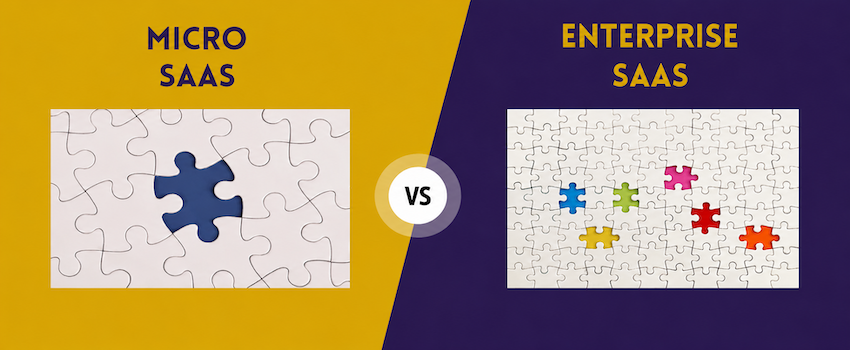
This decision is not just about product size. Instead, it affects:
-
- Your engineering hiring strategy
- Software outsourcing services requirements
- Product roadmap priorities
- SaaS architecture decisions
- Cloud infrastructure costs
- Customer acquisition model
- Pricing structure
- Investor expectations
- Operational complexity
- Product scalability
- Time-to-market strategy
- Long-term SaaS business growth
Moreover, I have noticed that many startup founders underestimate how dramatically this decision shapes operational culture. For instance, a Micro-SaaS startup often values speed, flexibility, and experimentation. On the other hand, enterprise SaaS companies usually prioritize process maturity, security governance, and predictable execution.
As a result, the choice between these two SaaS models impacts almost every strategic business decision moving forward.
What You’ll Learn in This Micro-SaaS vs. Enterprise SaaS Development Guide
In this guide, I’ll break down the practical differences between Micro-SaaS and Enterprise SaaS development from the perspective of someone who has led SaaS consulting projects, outsourced software development engagements, enterprise application modernization initiatives, and product engineering teams across multiple industries.
More importantly, I’ll help you answer the question every founder eventually faces: Should you build a lean niche SaaS product or a full-scale enterprise software platform?
If you’re serious about building a profitable SaaS company, this article will help you avoid expensive mistakes and make a smarter product strategy decision.
What is Micro-SaaS?
Micro-SaaS is a small, highly focused SaaS application designed to solve a specific pain point for a niche audience. Unlike traditional SaaS platforms, Micro-SaaS products intentionally keep the feature set narrow and operational overhead low.
Typically, a Micro-SaaS business includes:
-
- Small development teams
- Lean SaaS architecture
- Fast MVP development
- Subscription-based pricing
- Product-led growth
- Self-service onboarding
- Minimal customer support dependency
- Lower infrastructure costs
After all, the core idea behind successful Micro-SaaS development is simple. First of all, solve one painful problem exceptionally well. Do not try to become an all-in-one platform too early.
Why Micro-SaaS is Growing Faster Than Traditional SaaS Models
Over the past few years, Micro-SaaS development has exploded in popularity. Interestingly, this growth is closely tied to improvements in cloud infrastructure, AI-powered development tools, and no-code SaaS platforms.
For example, founders can now launch SaaS MVPs significantly faster using tools such as:
-
- GitHub Copilot
- Cursor
- OpenAI APIs
- Supabase
- Vercel
- Firebase
Consequently, the cost of SaaS product development has dropped dramatically for smaller products.
Additionally, founders are increasingly attracted to the operational simplicity of Micro-SaaS businesses. Instead of managing large engineering departments and enterprise procurement cycles, they can focus directly on solving customer pain points.
Common Micro-SaaS Product Examples and Use Cases
For example, some successful Micro-SaaS ideas include:
-
- AI-powered LinkedIn content schedulers
- Shopify inventory automation tools
- SaaS reporting dashboards for agencies
- GST reconciliation software for SMBs
- CRM plugins for niche industries
- Slack productivity bots
- Proposal automation tools
- SaaS analytics tools for ecommerce sellers
Many of these products generate significant recurring revenue despite operating with very small teams.
That is why Micro-SaaS business models have become increasingly attractive, especially for bootstrapped founders and startup entrepreneurs.
Additionally, AI-assisted software development tools have dramatically lowered the barrier to entry. Today, founders can use platforms like GitHub Copilot, Cursor, OpenAI APIs, and low-code SaaS frameworks to accelerate product development timelines.
However, that same accessibility has also increased competition. As a result, successful Micro-SaaS founders must focus heavily on differentiation, niche targeting, customer experience, and SEO-driven SaaS marketing.
What is Enterprise SaaS?
Enterprise SaaS refers to software platforms designed for large organizations with sophisticated workflows, security requirements, governance policies, and scalability demands.
FIND OUT: The CTO’s Guide to AI-Augmented Software Outsourcing in 2026
Unlike lightweight SaaS applications, enterprise software systems must support:
-
- Large user bases
- Multi-department workflows
- Advanced permissions
- Audit logging
- Regulatory compliance
- Enterprise-grade security
- High availability infrastructure
- Third-party integrations
- Workflow automation
- Role-based access control
- Data governance frameworks
Industries Where Enterprise SaaS Development Dominates
Enterprise SaaS products often serve industries such as:
-
- Healthcare
- Banking and fintech
- Insurance
- Manufacturing
- Logistics
- Telecommunications
- Retail operations
- Enterprise HR management
- Supply chain management
Examples include:
-
- ERP platforms
- Enterprise CRM systems
- Healthcare workflow platforms
- Banking automation software
- Manufacturing execution systems
- Enterprise procurement platforms
- Logistics optimization software
Unlike Micro-SaaS products, enterprise SaaS applications involve longer development cycles and far more engineering complexity.
However, they also create stronger competitive moats because enterprise systems become deeply embedded into organizational workflows. Consequently, customer retention rates are often much stronger.
Why Enterprise SaaS Creates Stronger Long-Term Business Defensibility
Enterprise software becomes deeply integrated into operational workflows. Therefore, switching costs increase substantially over time.
For example, replacing an enterprise procurement platform might require:
-
- Employee retraining
- Workflow redesign
- API reintegration
- Compliance validation
- Data migration
- Operational downtime planning
Because of that complexity, enterprise customers tend to remain loyal longer. As a result, enterprise SaaS businesses often benefit from predictable recurring revenue and higher customer lifetime value.
Why the Micro-SaaS vs. Enterprise SaaS Debate Matters More in 2026
The SaaS industry has changed dramatically over the past few years. AI has accelerated product development. Cloud infrastructure has become cheaper. No-code tools have reduced MVP timelines.
Meanwhile, competition has intensified across nearly every SaaS category. Because of these shifts, founders now need far more clarity before investing heavily in software product development.
Earlier, companies could afford to spend 18 months building products before validating demand. Today, that approach is extremely risky.
Modern SaaS founders need:
-
- Faster validation cycles
- Leaner development models
- Better product positioning
- Stronger differentiation
- Clear monetization pathways
- Sustainable customer acquisition strategies
That is exactly why choosing between Micro-SaaS and Enterprise SaaS development has become one of the most important strategic decisions for startup founders.
The Biggest Mistake Founders Make When Choosing Between Micro-SaaS vs. Enterprise SaaS
Most founders choose based on ambition instead of alignment. That is dangerous.
I have seen startups spend hundreds of thousands of dollars building enterprise-grade software architecture before achieving product-market fit. Eventually, many of those businesses collapsed because they optimized for scalability before validating demand.
At the same time, I have also seen founders build overly simplistic SaaS products in crowded markets with no defensible positioning.
The real question is not: “What sounds more impressive?”
The real question is: “What type of SaaS business aligns with my market access, operational capability, engineering maturity, and growth strategy?”
That mindset changes everything.
Furthermore, founders must evaluate their patience level honestly. Enterprise SaaS demands longer sales cycles, more stakeholder coordination, and slower onboarding. Meanwhile, Micro-SaaS requires relentless iteration and strong digital marketing execution.
Consequently, both paths require very different founder personalities.
Micro-SaaS vs. Enterprise SaaS: Core Differences Every Founder Should Understand
1. Product Development Complexity
Micro-SaaS development is significantly simpler. In most cases, founders can launch using:
-
- React or Vue frontend
- Node.js or Laravel backend
- PostgreSQL database
- Stripe subscription billing
- Vercel or AWS hosting
- Lightweight analytics tools
That is often enough for early-stage SaaS product validation.
Meanwhile, enterprise SaaS development introduces a completely different engineering landscape. Enterprise SaaS products usually require:
-
- Distributed system architecture
- Kubernetes orchestration
- Multi-region deployments
- Enterprise API management
- SSO authentication
- SAML integration
- SOC 2 compliance readiness
- HIPAA or GDPR alignment
- Audit logging systems
- Advanced DevOps pipelines
- Infrastructure observability
- Disaster recovery planning
Consequently, enterprise software engineering costs rise rapidly.
2. SaaS Development Timeline
Micro-SaaS products can launch very quickly. At CredibleSoft, we have helped founders launch lean SaaS MVPs in under 10 to 12 weeks. That speed matters because rapid validation reduces financial risk.
For example, one startup founder approached us with an AI-powered legal document summarization idea. Instead of building a massive enterprise contract intelligence platform immediately, we developed a focused SaaS MVP with:
-
- PDF upload functionality
- AI summarization
- Clause extraction
- Email sharing
- Subscription billing
- Usage analytics
The founder validated market demand within two months. Had the company attempted enterprise positioning immediately, the project would likely have required:
-
- Compliance audits
- Enterprise integrations
- Multi-user permission systems
- Procurement onboarding
- Security certifications
That could easily have delayed launch by over a year.
3. SaaS Customer Acquisition Strategy
Customer acquisition differs dramatically between these two SaaS business models. Micro-SaaS customer acquisition often relies on:
-
- SEO for SaaS websites
- Content marketing
- Product-led growth
- Organic search traffic
- SaaS affiliate marketing
- Social media marketing
- Community-driven adoption
Enterprise SaaS customer acquisition is relationship-heavy. Enterprise sales usually involve:
FIND OUT: Top Web & Mobile App Testing Companies in India (2026)
-
- Procurement reviews
- Legal approvals
- Technical architecture evaluations
- Executive buy-in
- Pilot implementations
- Vendor onboarding processes
As a result, enterprise SaaS sales cycles can last several months. However, enterprise contract values are significantly larger.
4. Operational Complexity
Operational complexity differs dramatically as companies scale. For instance, Micro-SaaS companies often operate effectively with lean teams and lightweight workflows. Meanwhile, enterprise SaaS businesses typically require:
-
- Dedicated DevOps engineers
- Security specialists
- Technical account managers
- Enterprise support teams
- Customer success departments
- Compliance consultants
Therefore, founders must prepare for a very different operational structure when entering the enterprise software market.
Micro-SaaS Advantages That SaaS Founders Often Overlook
1. Faster Iteration Cycles
Smaller SaaS products allow rapid experimentation. You can quickly test:
-
- SaaS pricing models
- onboarding flows
- feature adoption
- retention strategies
- conversion funnels
- UI improvements
That feedback loop is incredibly valuable.
2. Lower SaaS Infrastructure Costs
Micro-SaaS infrastructure remains relatively affordable. Many successful SaaS startups operate efficiently using:
-
- AWS Lightsail
- DigitalOcean
- Supabase
- Firebase
- Vercel
- Cloudflare
Meanwhile, enterprise SaaS infrastructure can become extremely expensive due to compliance, uptime guarantees, and enterprise scalability requirements.
3. Easier SaaS Product Management
Lean products are easier to manage operationally. Smaller feature sets reduce:
-
- QA complexity
- technical debt
- deployment risk
- support overhead
- engineering coordination
That operational simplicity helps founders move faster.
4. Better Opportunities for Bootstrapped Founders
Additionally, Micro-SaaS creates excellent opportunities for bootstrapped entrepreneurs.
Because development costs remain relatively manageable, founders can often reach profitability without relying heavily on venture capital funding.
As a result, they maintain stronger ownership and strategic independence.
Enterprise SaaS Advantages That Create Long-Term Revenue Stability
1. Higher Customer Lifetime Value
Enterprise SaaS contracts generate substantial recurring revenue.
One enterprise client may generate more ARR than hundreds of small SaaS subscriptions.
That changes how companies approach growth.
2. Stronger Competitive Defensibility
Enterprise software becomes deeply embedded into organizational workflows.
Once integrated, replacing the platform becomes operationally painful.
As a result, customer churn tends to be lower.
3. More Predictable Revenue
Enterprise SaaS businesses often benefit from:
-
- Annual contracts
- multi-year agreements
- account expansion opportunities
- onboarding fees
- premium support retainers
That creates stronger revenue stability.
4. Larger Expansion Opportunities
Enterprise accounts frequently expand over time.
For example, companies may initially adopt software within one department. Later, they often expand usage organization-wide.
Consequently, enterprise SaaS companies benefit from strong expansion revenue potential.
The Hidden Costs of Enterprise SaaS Development
Many founders underestimate enterprise software costs. Beyond development itself, enterprise SaaS products require investment in:
-
- Security audits
- Compliance consulting
- Infrastructure redundancy
- DevOps automation
- Performance optimization
- Documentation systems
- Enterprise support workflows
- User permission management
- Data governance policies
Additionally, enterprise clients expect reliability. Downtime is not tolerated. That means engineering standards must remain consistently high.
Why Enterprise SaaS Compliance Costs Are Higher Than Most Founders Expect
Many startup founders dramatically underestimate compliance complexity. For instance, enterprise customers may require:
- SOC 2 certification
- HIPAA compliance
- GDPR alignment
- Penetration testing
- Vendor security assessments
Consequently, compliance preparation alone can consume significant engineering bandwidth.
Choosing the Right SaaS Tech Stack for Development
1. Recommended Micro-SaaS Tech Stack
Layer |
Recommended Tools |
|---|---|
| Frontend | React / Next.js |
| Backend | Node.js / Laravel |
| Database | PostgreSQL |
| Hosting | Vercel / AWS |
| Billing | Stripe |
| Analytics | PostHog |
| Authentication | Clerk / Auth0 |
Keep the stack simple. Do not over-engineer early-stage SaaS products.
2. Recommended Enterprise SaaS Tech Stack
Layer |
Recommended Tools |
|---|---|
| Infrastructure | Kubernetes |
| Cloud Platform | AWS / Azure |
| Monitoring | Datadog |
| Authentication | Okta / SAML |
| Messaging | Kafka |
| DevOps | GitHub Actions |
| Observability | New Relic |
| Security | Vault / IAM |
Enterprise software architecture must prioritize scalability, resilience, and security from day one.
SaaS Outsourcing Strategy: What Founders Need to Know
At CredibleSoft, we work extensively with startup founders and enterprise clients on outsourced SaaS development projects. One pattern appears repeatedly: Founders underestimate how different outsourcing becomes across these two SaaS models.
1. Outsourcing Micro-SaaS Development
Micro-SaaS outsourcing works best with lean, agile teams. Founders should prioritize:
-
- rapid MVP development
- flexible sprint execution
- iterative product design
- startup-focused engineering culture
An ideal Micro-SaaS outsourcing team may include:
-
- One full-stack developer
- One frontend engineer
- Shared QA resources
- Fractional UI/UX support
The goal is speed and adaptability.
2. Outsourcing Enterprise SaaS Development
Enterprise SaaS outsourcing requires much more maturity. You need:
- Structured architecture planning
- Technical documentation standards
- Enterprise QA automation
- Security-first development practices
- Scalable DevOps pipelines
- Governance-focused sprint management
Enterprise software development cannot rely on improvisation. Process maturity becomes essential.
Additionally, communication quality becomes far more important as enterprise projects scale. Therefore, founders should prioritize outsourcing partners with strong project governance and transparent delivery processes.
How AI Is Reshaping Micro-SaaS vs. Enterprise SaaS Product Development
AI is transforming the SaaS industry rapidly. However, its impact differs significantly across Micro-SaaS and Enterprise SaaS.
FIND OUT: SaaS Production Readiness Checklist: Pre-Release Testing & Go-Live Validation for Founders
1. AI and Micro-SaaS
AI dramatically accelerates Micro-SaaS development. Founders can now:
- Build MVPs faster
- Automate support workflows
- Generate content
- Improve onboarding
- Enhance customer insights
- Reduce operational overhead
As a result, Micro-SaaS competition is increasing rapidly.
2. AI and Enterprise SaaS
Enterprise SaaS benefits from AI differently. Here, AI enhances:
- Workflow automation
- Predictive analytics
- Enterprise reporting
- Document processing
- Operational intelligence
However, enterprise adoption still depends heavily on:
- Compliance
- governance
- security
- integration compatibility
Therefore, enterprise software retains stronger long-term defensibility.
Common Scaling Mistakes in Micro-SaaS and Enterprise SaaS Startups
1. Overengineering Too Early
This is extremely common. Founders often build for hypothetical scale instead of current demand. You do not need distributed microservices architecture for your first 500 users. Start lean. Scale intentionally.
2. Ignoring Customer Retention
Many founders obsess over acquisition while ignoring retention. Retention is the real SaaS growth engine. High churn destroys even strong acquisition pipelines.
3. Weak SaaS Positioning
Generic SaaS products struggle. The market rewards specialization. Strong niche positioning almost always outperforms vague “all-in-one” messaging.
4. Scaling Teams Too Quickly
Additionally, many SaaS founders hire aggressively before operational processes mature. Consequently, engineering coordination becomes chaotic and delivery velocity declines. Instead, founders should scale teams gradually while improving systems, documentation, and communication processes.
A Practical Framework for Choosing Between Micro-SaaS vs. Enterprise SaaS
1. Choose Micro-SaaS If:
-
- You want rapid SaaS MVP development
- You’re bootstrapping
- You prefer lean startup execution
- You want faster validation
- You rely on SEO-driven acquisition
- You want operational simplicity
- You prefer smaller teams
2. Choose Enterprise SaaS If:
-
- You have enterprise industry expertise
- You understand complex workflows
- You possess enterprise relationships
- You can handle long sales cycles
- You want higher ARR potential
- You can invest in compliance and security
- You’re building for long-term defensibility
FAQs: Choosing Between Micro-SaaS vs. Enterprise SaaS
1. Is Micro-SaaS better for startup founders?
For many first-time founders, yes. Micro-SaaS offers faster validation, lower development costs, and simpler operational management. However, enterprise SaaS may be better if you possess deep industry expertise and strong enterprise relationships.
2. What is the biggest difference between Micro-SaaS and Enterprise SaaS?
The biggest difference lies in complexity. Enterprise SaaS products require advanced scalability, compliance, integrations, governance, and enterprise workflow support, while Micro-SaaS focuses on solving narrow niche problems quickly and efficiently.
3. Can outsourced software development work for SaaS startups?
Absolutely. Many successful SaaS startups rely on outsourced software development teams for faster execution and lower operational overhead. However, the outsourcing model should align carefully with the SaaS business type.
4. How much does SaaS product development cost?
Micro-SaaS MVP development may cost anywhere from $15,000 to $60,000, while enterprise SaaS development can easily exceed several hundred thousand dollars due to infrastructure, compliance, integrations, and scalability requirements.
5. Is enterprise SaaS more profitable than Micro-SaaS?
Enterprise SaaS can generate significantly larger contract values and stronger long-term retention. However, it also requires larger investments, longer sales cycles, and more operational complexity.
Final Verdict: How to Choose the Right SaaS Business Model for Your Business
Choosing between Micro-SaaS and Enterprise SaaS development is not about prestige. It is about alignment. The best founders understand their strengths honestly. They evaluate their market access, technical capability, operational maturity, funding runway, and customer acquisition strengths before committing to a SaaS product strategy.
If you are early in your founder journey, I strongly recommend prioritizing validation, execution speed, and customer learning over oversized architectural ambition. Launch faster. Learn faster. Iterate faster. Then scale strategically.
At CredibleSoft, we help startups, founders, and growing businesses build scalable SaaS products through custom software development, SaaS consulting, enterprise application development, cloud-native engineering, AI-powered product development, and dedicated development team services. Whether you are planning a lean Micro-SaaS MVP or a large-scale enterprise SaaS platform, our engineering and product strategy teams can help you validate ideas, optimize architecture, accelerate development, and reduce execution risk.
If you are evaluating your next SaaS product idea or planning a digital transformation initiative, I’d encourage you to schedule a strategy discussion with the CredibleSoft team. A single architecture decision made early can save months of engineering rework later. The smartest SaaS founders do not just build products. They build with clarity.

About the Author: Debasis Pradhan is the Founder and CEO of CredibleSoft, a global leader in software QA and development. With over 20 years of hands-on experience in test automation, software quality engineering, and digital transformation, he is known for his unwavering commitment to delivering enterprise-grade software solutions with precision and reliability. 🔔 Follow Deb on LinkedIn